A Technical Comparison of Gerhard Richter’s and Margus Veisveer’s Oil Painting Processes
When we speak about oil painting, we usually assume that the artist applies paint to the surface. A brush takes up paint and transfers it onto the canvas. A scraper may spread, remove or smooth the paint. Technique is usually described in terms of how the artist applies the material.
But what happens when the central action of painting is not applying paint, but directing the movement of pigment?
At that point, even the question of what actually constitutes the painting begins to change.
Gerhard Richter’s abstract paintings provide an especially useful point of comparison. Not because his method is similar to mine, but because the difference is revealing: in both cases oil paint is released from conventional brush painting, yet its physical behavior is controlled in fundamentally different ways.
Richter: the painting as a layered process
Gerhard Richter’s technique for abstract painting became particularly distinct from the 1980s onward. Museum sources describe his method as the successive application and removal of layers of paint. Paint is applied to the surface and then dragged across the wet surface with a large squeegee - a long, flexible-bladed tool that moves the paint mass, blends layers and scrapes paint away in places. A new layer may then be added and the process repeated.
For example, in Abstract Painting 780-1 from 1992, the National Gallery of Art describes Richter pulling a long squeegee across the canvas, smearing paint and exposing underlying layers. Changes in pressure or pauses in the movement leave bands of different width and density on the surface.
One of the defining characteristics of Richter’s technique is therefore the visibility of accumulated time.
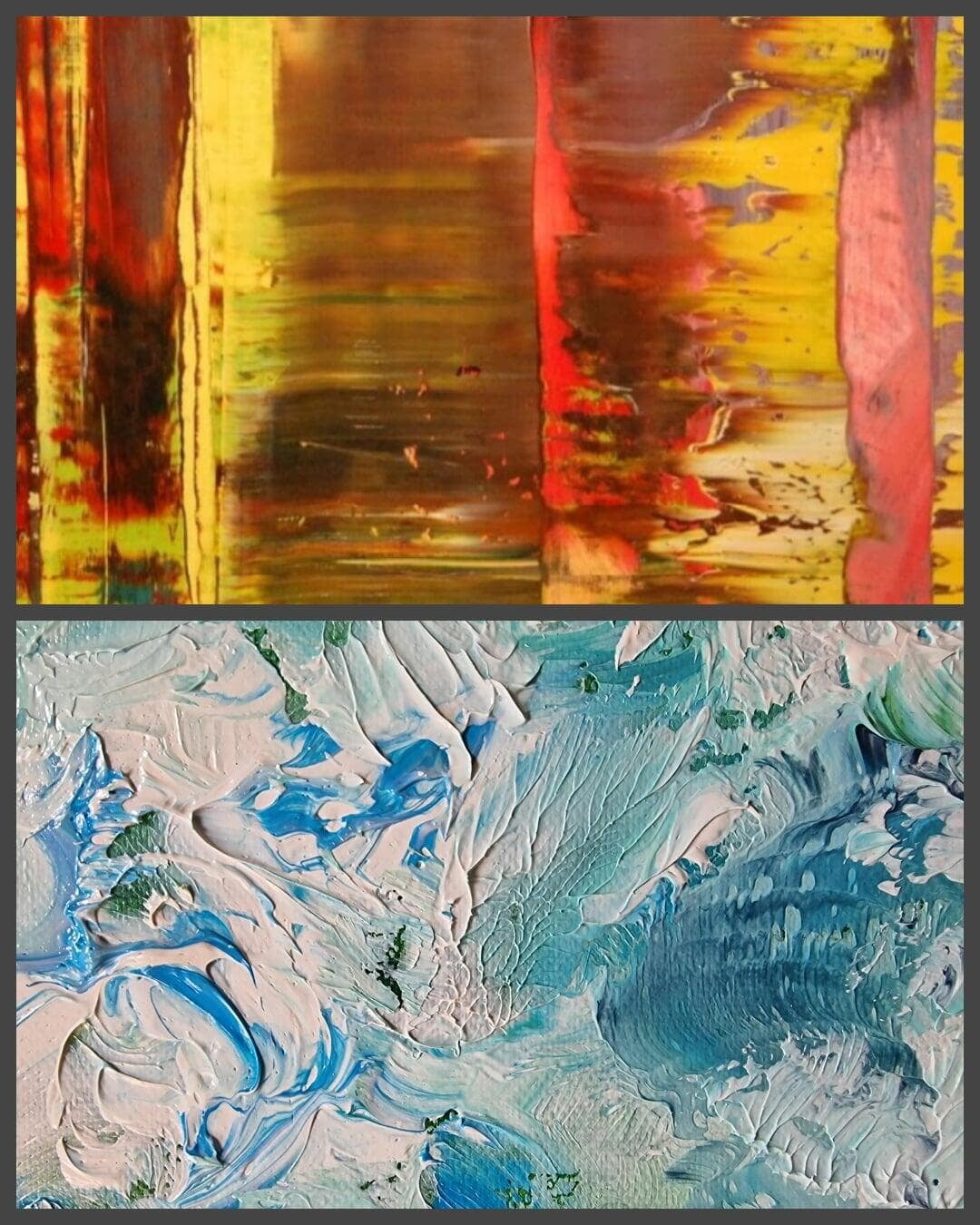
The painting does not come into existence all at once. Its surface contains previous states: paint has occupied one place, then been moved to another, partly removed, covered by new paint and worked through again. Some earlier layers remain; some reappear; others almost disappear completely.
SFMOMA describes Richter’s process as a highly physical process taking place over an extended period, in which layers are added and removed and the squeegee moves the paint layers across the surface.
The National Galleries of Scotland likewise emphasizes that the final surface develops through numerous successive states and that the tracks of the squeegee remain visible in the finished work.
Richter’s painting therefore makes it possible to see the history of its own making.
One stroke can affect a large mass of paint
The scale of Richter’s squeegee is technically important.
The Jordan Schnitzer Museum of Art describes his method as first applying paint with a brush and then moving a long, flexible acrylic-bladed, homemade squeegee horizontally or vertically across the canvas.
The nature of this tool determines the scale of the movement.
A single pull can affect a large area of the painting. The paint mass moves, layers merge, some paint is removed and parts of the underlying layer become visible. Broad color fields, streaks, accumulations, thinned passages and ruptures emerge.
Richter’s technique is highly physical, but it is also deliberately open to chance. One of the aims of the method is to allow the painting to develop into something that was not completely predetermined by the artist.
His process can therefore be summarized as:
apply paint » move paint » remove paint » add another layer » move and remove again » assess » enter another state.
The painting emerges through successive states.
Veisveer: the painting completed in a single session
The starting point of my recent oil paintings is different.
The painting is completed within a single painting session. This does not mean that the process is quick or simple. On the contrary: the entire decision-making process is concentrated within that session - the placement of pigment, the direction of movement, pressure, changes in speed, changes of direction, gathering and dispersing.
The important difference is that I do not construct the painting through Richter’s repeated cycles of adding and removing layers.
I do not use a brush to direct the pigment.
Nor do I use conventional painting scrapers or tools designed for painting for this purpose.
I use small, flexible tools that were not originally designed for painting.
This detail is not, in itself, the essence of the technique, but it reveals something important: the tool does not come with a predetermined painterly gesture.
Instead, the tool becomes an instrument for directing the movement of pigment.
This distinction matters.
A brush is designed to apply paint.
A squeegee is designed to pull across a surface and move a mass of paint.
The flexible tools I use allow pigment to be directed on a different scale and with a different sensitivity: rather than simply dragging paint from one place to another, they influence its movement through very small changes.
Pigment is not simply color here
In this technique, it is important to distinguish between paint and pigment.
Paint is the finished painting material.
Pigment is the carrier of visible color.
When I speak of directing pigment, the question is not simply where paint is placed on the canvas. The question is how the concentration and movement of pigment change across the surface.
Pigment can be:
- directed,
- slowed,
- accelerated,
- gathered,
- dispersed,
- redirected from one movement into another,
- allowed to accumulate briefly and then guided outward again.
These are not isolated decorative effects. Their repetition creates the final surface.
The fundamental structure of the painting therefore does not come from a single visible brushstroke.
It emerges from the cumulative effect of many small movements of pigment.
Macro-movement and micro-movement
This is where the comparison with Richter becomes particularly revealing.
Richter’s squeegee operates on a large scale. The long flexible blade crosses a substantial area of the canvas and affects a large mass of paint at once. As a result, the trajectory of the tool can often be read in the finished surface: a vertical or horizontal pull, an accumulation of paint, a thinning of the layer, a rupture or the exposure of an underlying layer.
My paintings produce the opposite phenomenon.
The individual movement does not necessarily remain visible to the viewer.
What matters is its microscopic effect.
Pigment is directed through very small changes. The movement is repeated, altered and corrected. One movement affects the next, while the next visually transforms what came before.
The resulting surface is therefore not the trace of a single tool but a field of movement.
This is why a painting may appear from a distance as a unified field of color or light, while from close range it begins to break apart into a multitude of microstructures.
The viewer is no longer seeing only color.
The viewer begins to see how the pigment has moved.
Two different ways of controlling paint
This is perhaps the most precise way to formulate the difference between Richter’s technique and mine.
Richter manipulates the paint layer.
I direct the movement of pigment within the paint.
In Richter’s process, the central action is the physical displacement, blending and removal of the paint layer. An underlying layer may become visible; an upper layer may rupture or merge with the one beneath it.
In my process, the central action is the organization of pigment movement.
This is not simply dragging paint across the surface.
The movement of pigment can be directed so that the flow changes: it slows, accelerates, gathers, disperses and changes direction.
Why can the result resemble watercolor?
One of the interesting characteristics of my recent oil paintings is that certain transitions may resemble watercolor.
The material, however, is not watercolor.
It is oil paint.
The watercolor-like effect does not come from turning oil paint into watercolor, but from the distribution of pigment.
When pigment concentration changes gradually, color can move visually towards an almost transparent appearance. Stronger pigment concentration gathers in one area, while in another the presence of pigment becomes progressively more dispersed.
The transition therefore does not necessarily arise from the classical logic of “color A + color B = color C”.
Instead, it emerges through a change in pigment density across space.
This is what creates the unusual viewing experience.
A surface that changes with viewing distance
This leads to another important difference.
In a Richter painting, moving closer can reveal squeegee marks, layers, accumulations of paint and evidence of removal. In other words, the physical history of the painting becomes visible.
In my paintings, something else becomes visible.
The unified color field begins to break apart.
Micro-transitions, differences in pigment density, extremely small directional movements and structures that cannot be fully perceived from a distance begin to emerge.
Viewing distance is therefore not merely an aesthetic consideration in my paintings.
It is part of the technical result.
The painting does not reveal itself all at once.
It changes according to how close the viewer stands to it.
The meaning of completing the painting in one session
Completing the painting in a single session gives the technique another important characteristic.
For Richter, the painting is a process in which a previous state can become material for the next one. The painting can be one thing today, another tomorrow, and something entirely different after several cycles of working and reworking. In his abstract paintings, this layered development is an integral part of the method.
In my process, the opposite is important: the continuity of one sustained movement.
The painting is not constructed as an architecture of corrections, removals and revisions accumulated over a long period.
Instead, pigment movement is continuously directed within a single session until the entire field reaches the required state.
This also changes the meaning of error.
When a painting develops within one continuous process, every deviation cannot simply be painted over and erased later. The pigment has to be directed in such a way that the previous movement becomes part of the next one.
The technique is therefore simultaneously controlled and irreversible.
The painting is not built up - it is directed into a state
This may be the most precise way to describe my current working method.
I do not build the painting up in the conventional sense.
I direct the painting material into a state in which it becomes the painting.
The basic unit of the process is therefore not the brushstroke or the paint layer.
The basic unit is the movement of pigment.
One movement affects the next.
The next transforms the previous one.
Pigment concentration changes.
The flow slows.
Accelerates.
Gathers.
Disperses.
Changes direction.
And eventually a whole emerges that cannot be reduced to any single movement.
The technical difference in one sentence
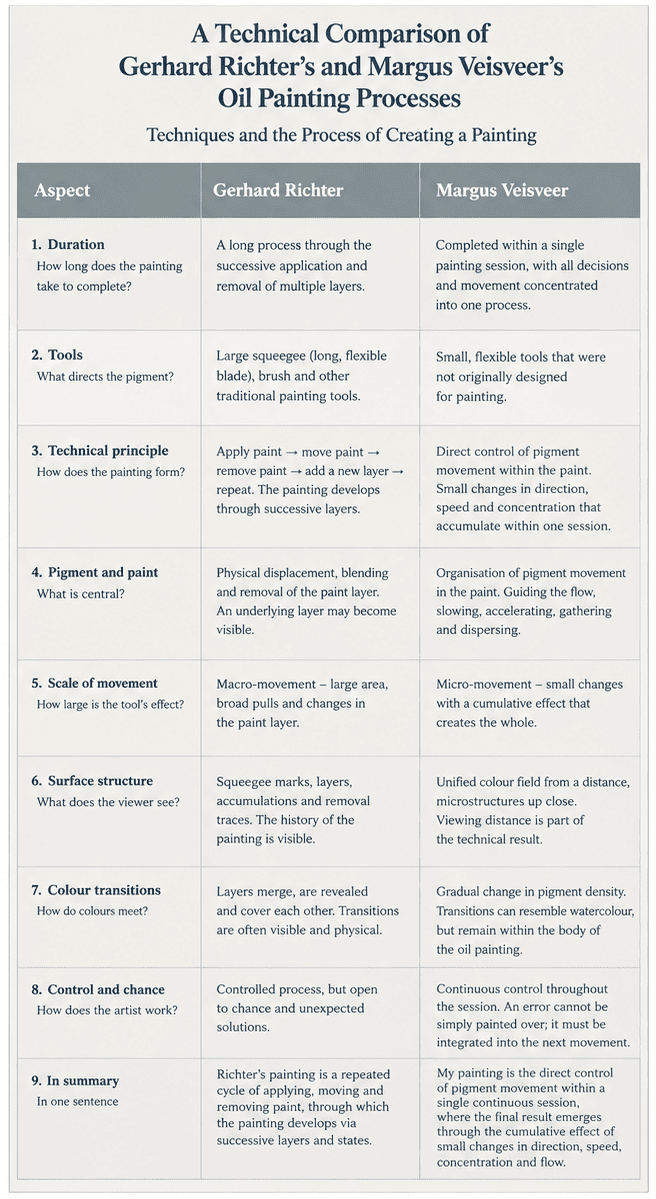
Gerhard Richter’s process can be described as a repeated cycle of applying, moving and removing paint, through which the painting develops through successive layers and states.
My process is the direct control of pigment movement within a single continuous painting session, in which the final result emerges through the cumulative effect of small changes in direction, speed, concentration and flow.
These are two different ways of using the physical nature of oil paint.
In one, the artist manipulates the paint layer.
In the other, the artist manipulates the movement of pigment within the paint layer.
And this is where oil painting becomes, for me, something more than the application of color to canvas.
Impressionism changed what is seen in a painting.
My paintings change how a painting is viewed.