Artist Biography
Margus Veisveer (b. 1968) is an Estonian painter whose work explores time, perception, and the transformation of landscape. He graduated from the Tartu Art School in 1987.
In the late 1980s, Veisveer participated in exhibitions organized within the Soviet Union, including shows in Moscow. Following Estonia’s restoration of independence, he worked as an art educator and, from 1995 onwards, as a designer in the private sector. He brings over two decades of experience in visual communication and web-based graphic design, having developed logos and visual identities for hundreds of Estonian companies.
In 2024, Veisveer shifted his professional focus entirely to painting , marking a return to his artistic practice with a renewed emphasis on time-based perception and spatial transformation. In 2025, he presented a series of solo exhibitions in major Estonian cities, including Tartu and Kohtla-Järve, as well as in Southern Estonia. In 2026, his work was presented in Italy and Spain, alongside a new solo exhibition in Tallinn.
Margus Veisveer has developed a method of painting in which pigment is deliberately directed rather than conventionally applied. This method generates a distinct visual language through which contextual, spatial and temporal subjects can be constructed.
The painting is experienced through changing distance.
From a distance, the image emerges. As the viewer approaches, the physical and optical reality of the pigment begins to reveal itself. Moving back again restores the image, while moving closer reveals another layer of perception. The viewer's movement toward and away from the painting is therefore not incidental - it is part of the work itself.
I am an Estonian contemporary artist exploring time as a visible structure within landscape, memory, and perception. My work moves between observation and imagination, revealing how environments are not fixed, but continuously shift across temporal layers.
Working primarily in oil, I combine expressive gesture with conceptual clarity. My practice is rooted in the Mediterranean - its light, water, and layered surfaces - yet I do not depict it as it is. I approach it as a field of time, where reflections, depths, and structures carry traces of past, present, and imagined futures within a single image.
I do not paint the sea - I work with phase transitions. The surface is not simply an image, but a field where time, force, and resistance become visible. The work is not only to be seen, but to be physically and perceptually encountered.
For me, understanding where I am and where I am heading is essential. Direction provides clarity, but it is not fixed. The work emerges in moments where control and unpredictability meet, and where the narrative becomes perceptible through tension.
While these ideas define the conceptual direction of my work, they are inseparable from the behaviour of the material itself. Over time, my studio practice has shifted from representing natural phenomena towards constructing paint layers in which oil paint becomes an active participant in the creation of light, movement and perception.
This has led to a fundamental change in my method. I increasingly work not by applying pigment in the conventional sense, but by directing its movement. Small, flexible tools allow me to guide the pigment through repeated micro-movements, changing its flow, pressure, speed and direction.
The result is not simply a surface with texture. It is a physical structure in which the behaviour of the pigment becomes part of the image itself.
My paintings do not become meaningful because a hidden image is revealed within abstraction. They become readable when the viewer begins to understand how pigment, movement, space and context are working together.
Distance does not merely reveal detail; it changes the way the painting is read. At close range, the viewer encounters the physical behaviour of the material. From further away, these microstructures begin to resolve into a larger perceptual field.
This is where my current practice is heading: from painting an image towards constructing the conditions in which an image, light and movement can emerge through the material itself.
Studio Notes
On the Material Behaviour of Oil Paint
Working notes from the studio on the relationship between light, water and the physical behaviour of oil paint.
Introduction
(Working notes on the evolution of my painting process)
Looking back, I realise that something much more fundamental has gradually changed.
The transition was not a stylistic decision, nor was it about abandoning representation. It was a slow shift in the logic of painting itself.
In earlier works, paint was primarily used to depict water.
Today my interest lies elsewhere.
I try to construct the paint layer so that oil paint itself begins to behave according to the optical and physical principles we associate with water.
The difference may appear subtle.
Technically, however, it changes almost everything.
Why Light Is Not Painted
Light Does Not Come Only from Colour
Traditional painting usually creates light through tonal relationships...
In my recent work, light increasingly emerges from the physical structure of the paint layer itself...
Rather than illustrating reflected light, the material generates optical events of its own.
What the Brush No Longer Does
Flow Does Not Follow the Brush
One of the most noticeable changes in my work is that movement is no longer determined solely by brush direction...
Earlier paintings relied largely on brushstrokes...
Today movement develops through the behaviour of the paint itself...
Viscosity.
Gravity.
Surface tension.
Layer interaction.
The brush remains present, but it is no longer the sole author of movement.
Microstructures
At close viewing distances another level becomes visible...
Small cellular formations.
Interrupted membranes.
Semi-transparent accumulations.
Edges where one layer begins to separate from another.
These structures are not decorative texture.
They are part of how the painting produces light.
The optical complexity begins long before the viewer recognises an image.
The Changing Role of the Brush
Earlier works reveal the brush more directly.
Individual strokes organise the image.
In more recent paintings the brush becomes less visible.
Its role shifts from describing form to initiating physical processes within the paint.
Instead of asking,
How was this brushstroke made?
the viewer may begin asking,
How does the paint behave like this?
No painter works outside history.
Turner...
Monet...
Gerhard Richter...
Rather than representing water more convincingly, I am interested in allowing oil paint itself to embody some of the optical and physical behaviour we associate with water.
Comparing Earlier and Recent Works
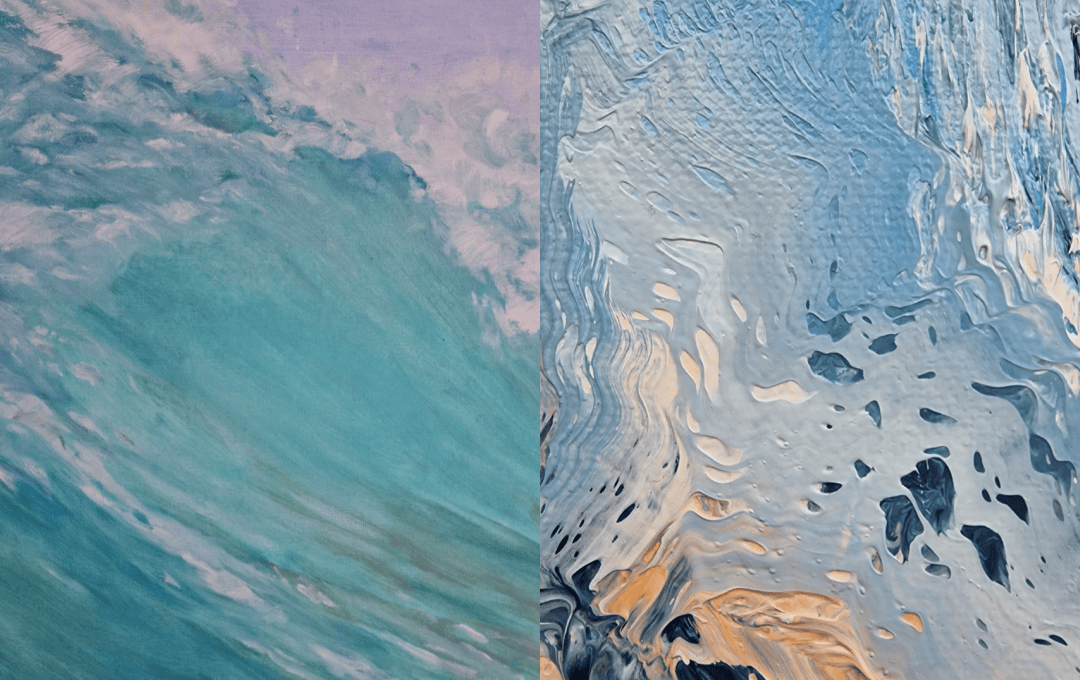
Looking at these two fragments, painted years apart, the evolution becomes visible.
In the earlier fragment, paint describes water.
Brushstrokes organise movement and tonal relationships create light.
In the more recent fragment, the paint layer itself becomes more active.
Light emerges through physical structure.
Movement develops through viscosity, gravity and layered interaction.
Paint no longer simply depicts water.
It begins to behave like it.
The greatest development in my work has not been colour.
Nor composition.
Nor subject matter.
It has been the changing relationship between artist and material.
Earlier I controlled paint.
Today I increasingly construct situations in which the material participates in creating the image.
This is not about chance.
It is about understanding exactly when control should give way to the physical intelligence of oil paint itself.
Where the Real Innovation May Lie
If there is something genuinely new in my work, I do not believe it lies in painting water differently.
It lies in shifting attention from representation towards material behaviour.
The painting is no longer only an image of water.
It becomes an event taking place within oil paint itself.
Light emerges from the physical organisation of the material.
Movement emerges from the interaction of layers.
The viewer experiences not only an image but also the behaviour of matter.
Looking back, I believe this is the most fundamental transition in my practice.
It is less immediately visible than colour or composition, yet it concerns something deeper: the logic of painting itself.
An observed perceptual effect resulting from the controlled movement of pigment.
The painting is not perceived as a fixed image. Its visual structure changes with viewing distance. At close range, pigment movement reveals micro-transitions and relationships that gradually integrate into a different visual whole from a greater distance. The painting therefore does not simply contain an image - it creates different perceptual states depending on how it is viewed.