Comparative Framework
I position my work in dialogue with artists such as Gerhard Richter, J. M. W. Turner, and Anselm Kiefer, as well as in contrast to Vija Celmins and Hiroshi Sugimoto.
What connects these practices is not subject matter, but a shared concern with materiality, time, and perceptual tension.
Statement
My work exists between image and dissolution, where form begins to resist its own stability and movement becomes unavoidable.
I am not interested in depicting the sea as an object, but in approaching it as a state of transition — a moment where time, force, and matter converge.
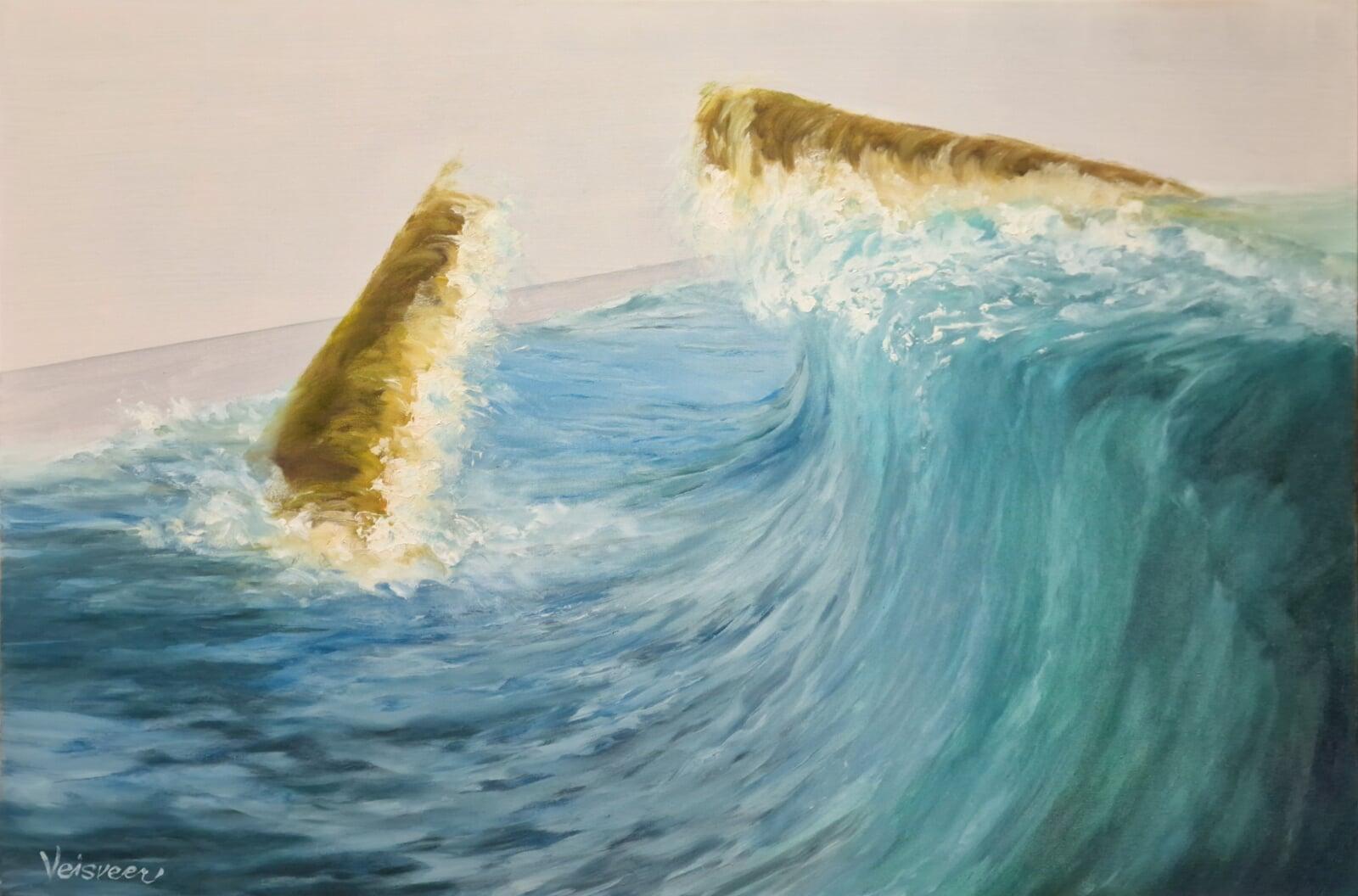
Positioning
Like Richter, I engage with the instability of the image, yet my focus is less on distance and more on physical presence.
Like Turner, I approach the sea as an event rather than a form, though instead of dissolving it into light, I compress it into tension.
Like Kiefer, I treat material as a carrier of time, but without relying on historical or symbolic narratives — my work is grounded in direct, perceptual experience.
In contrast, where Celmins suspends time into stillness, I work with its rupture.
Where Sugimoto reduces the sea to a horizon, I focus on the moment just before transformation.
Gerhard Richter
Why:
My work, like Richter’s, operates in the tension between image and dissolution — where representation is present but destabilized.
Comparison points:
- Disruption of the image surface
- Compression of time into a single frame
- Balance between control and chance
Key difference:
My paintings carry more physical force — less detachment, more embodied pressure.
J. M. W. Turner
Why:
Turner painted not the sea itself, but the breakdown of light and atmosphere into motion — something closely aligned with my approach.
Comparison points:
- Fusion of light and matter
- Dissolution of form into movement
- Atmosphere as structure
Key difference:
Where Turner dissolves, my compress — my work holds tension at the edge of form.
Anselm Kiefer
Why:
A shared emphasis on material as meaning — surface not as depiction, but as a carrier of time.
Comparison points:
- Texture as narrative
- Surface as memory
- Physical weight of the work
Key difference:
Kiefer is historically and symbolically loaded; my work is more phenomenological — rooted in direct experience rather than reference.
Vija Celmins
Why:
Her ocean surfaces offer a powerful counterpoint: stillness versus my sense of imminent movement.
Comparison points:
- Repetition vs. energy
- Stillness vs. tension
- Suspended time vs. transitional time
Hiroshi Sugimoto
Why:
Sugimoto reduces the sea to a timeless horizon; my work captures the moment just before transformation.
Comparison points:
- Time as a perceptual construct
- Minimal structure vs. intensity
- Viewer’s temporal experience
My work operates between Richter’s perceptual instability, Turner’s dissolving light, and Kiefer’s material weight — yet distinguishes itself through a focused engagement with moments of transition, where form resists and movement insists.
What Defines My Work
I do not paint the sea — I work with phase transitions.
The surface is not an image, but a field where time, force, and resistance become visible.
The work is not only to be seen, but to be physically and perceptually encountered.