Parallels to 2 sec

Art-Theoretical Parallels to 2 sec (shut down) (2025)

Margus Veisveer’s 2 sec (shut down) occupies a unique position within contemporary painting, merging geometric abstraction, atmospheric nature, and post-digital conceptual thinking. The painting does not directly reference any specific predecessor, yet several art-historical trajectories resonate with its visual logic and philosophical undertones.
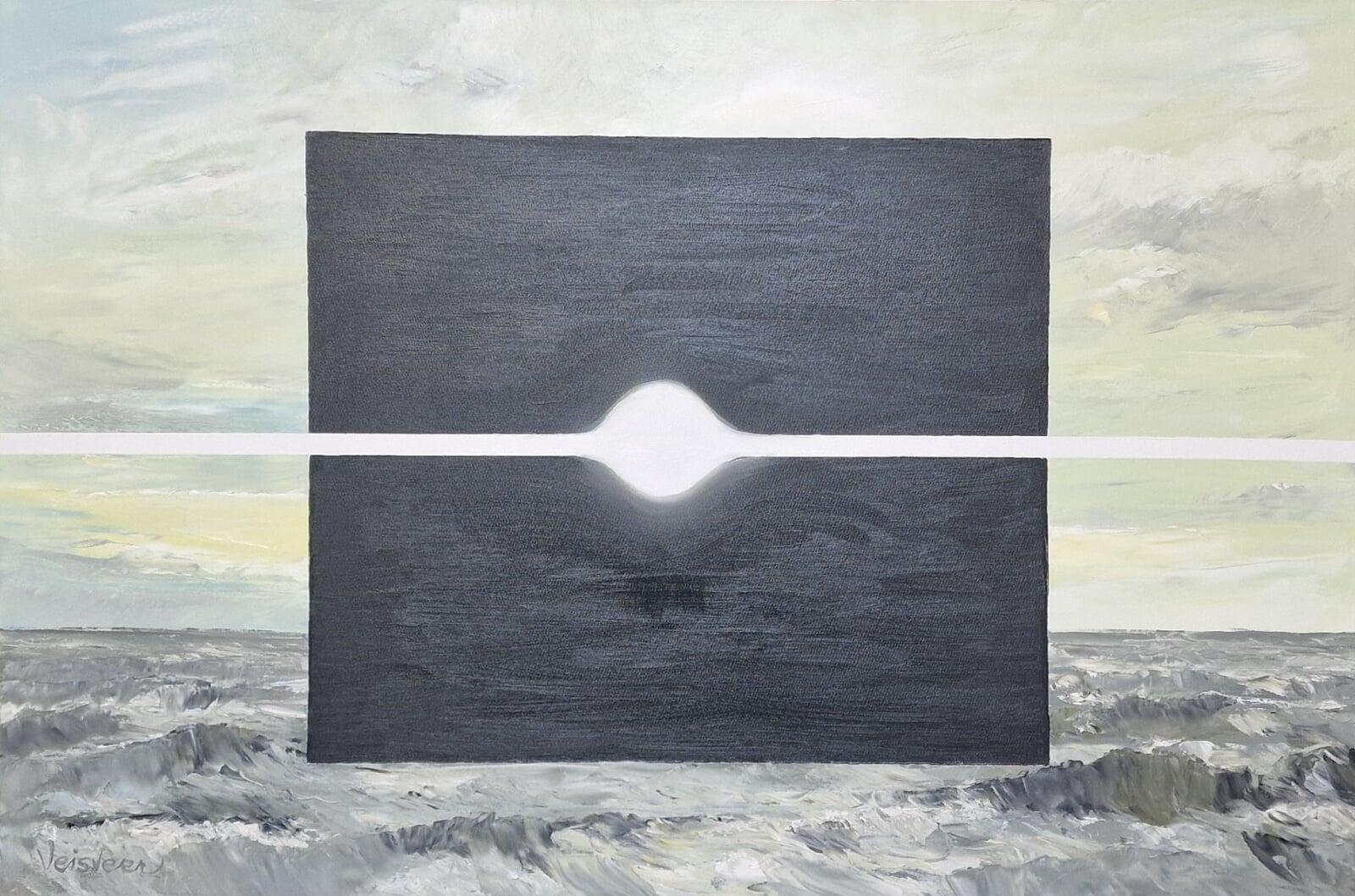
2 sec (shut down)
2 sec (shut down), oil on canvas, 80 × 120 cm, 2025, by Margus Veisveer.

1. Kazimir Malevich – geometric rupture as zero-state

Malevich’s Black Square marked a radical break—a visual shutdown of representational reality.
Veisveer recontextualises the square within nature, transforming it from a metaphysical void into an intrusive force, prompting questions about who initiates the shutdown: nature, technology, or humanity.


Parallel: the black form as absolute limit.
Difference: Malevich’s square exists outside the world; Veisveer inserts it into the world.


2. Barnett Newman – the line as existential threshold

Newman’s zip acts as a metaphysical division within a field.
Veisveer’s horizontal white line functions similarly but operates as a temporal and technological signal: the instant before shutdown.


Parallel: the line as boundary.
Difference: Newman avoids narrative, ecology, and technological reference.


3. Mark Rothko – inner luminosity within darkness

Rothko’s fields radiate inward-facing, psychological light.
Veisveer’s glowing core echoes this but anchors it in the temporal logic of a system approaching collapse.


Parallel: light as existential intensity.
Difference: Rothko’s light is timeless; Veisveer’s is tensioned by imminence.


4. Olafur Eliasson – artificial light in atmospheric nature

Eliasson merges technological light with natural perception to create hybrid sensory spaces.
Veisveer compresses this dynamic into a single painted frame where nature and technological interruption coexist.


Parallel: interference between the natural and artificial.
Difference: Eliasson works spatially; Veisveer compresses the concept into image.


5. Anish Kapoor – black forms as sites of absorption

Kapoor’s black voids consume space and diminish visibility.
Veisveer’s square similarly interrupts and absorbs—but allows light to break through.


Parallel: the black form as gravitational centre.
Difference: Veisveer assigns narrative meaning (shutdown, transition).


6. Hiroshi Sugimoto – the horizon as existential zero-line

Sugimoto’s Seascapes depict the horizon as an eternal constant.
Veisveer adopts this archetype only to disrupt it with geometric intrusion and technological light.


Parallel: the sea as primordial order.
Difference: Sugimoto preserves continuity; Veisveer fractures it.


Conclusion

2 sec (shut down) stands not as a continuation but as a convergence of:

  • Malevich’s radical abstraction,

  • Newman’s thresholds,

  • Rothko’s inner light,

  • Eliasson’s post-digital atmospheres,

  • Kapoor’s void-forms,

  • and Sugimoto’s metaphysical horizon.


From this convergence emerges an image that is unprecedented—an existential moment suspended between disappearance, transformation, and reconnection.
Veisveer constructs a visual logic that belongs distinctly to the post-digital present yet remains timeless in its philosophical reach.


Margus