The representation of time
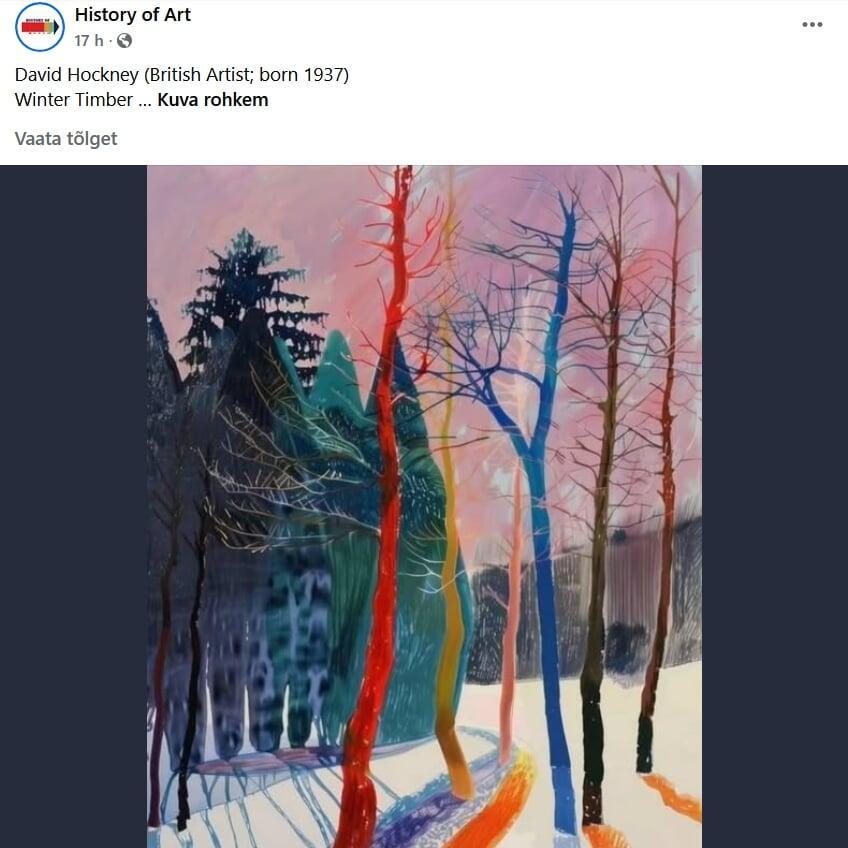
A painting occupies space. It is static, fixed, and visible all at once. Yet our experience of the world is neither static nor instantaneous. We move through landscapes, memories overlap, events unfold, and perception itself develops through time. For this reason, many artists have searched for ways to move beyond the idea of painting as a frozen moment. Among contemporary painters, David Hockney has explored this question extensively. His painting Winter Timber provides an interesting point of comparison with my own Timeline series because both bodies of work challenge the traditional notion of a single captured instant. Yet they do so in fundamentally different ways.
Hockney: Time Through Movement
At first glance, Winter Timber appears to be a winter landscape. Bare trees stand against a pale sky, a path curves through the snow, and brightly coloured trunks punctuate the composition.
However, the painting is not primarily concerned with describing a specific place.
Hockney has often questioned the limitations of photographic vision. A photograph captures a fraction of a second from a single viewpoint, but human perception operates differently. We scan, move, remember, compare, and continuously reconstruct our surroundings.
In Winter Timber, the viewer's eye travels through the painting much as a person walks through the landscape itself. The path becomes a visual guide, leading us forward. The coloured trees function almost as markers along a journey. Rather than presenting one fixed moment, the painting accumulates multiple moments of looking.
Time enters the work through movement.
The viewer experiences the landscape sequentially, constructing it through attention and observation.
In this sense, Hockney transforms space into an experience of duration.
The Timeline Series: Time as Structure
The Timeline series begins from a different premise.
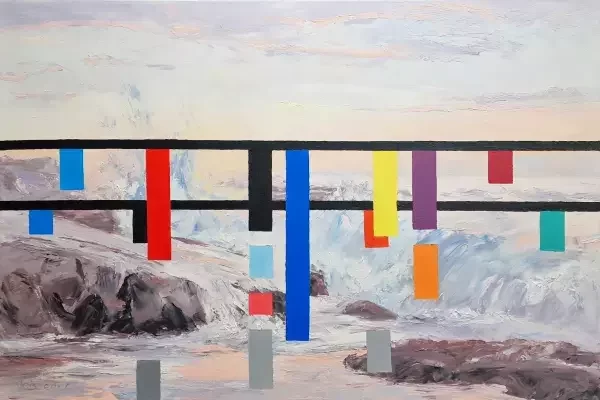
Instead of extending a moment through movement, the work collapses multiple moments into a single image.
Events, fragments, memories, and temporal layers coexist simultaneously. The painting is not organised around a journey through space but around the interaction of different moments in time.
Where Hockney's viewer progresses through a landscape, the viewer of a Timeline painting encounters several temporal realities at once.
The image does not unfold chronologically.
Past and present become visible together.
The work therefore asks a different question.
Not: How do we move through time?
But rather: What happens when multiple moments occupy the same visual field?
This shift changes the role of the viewer. Instead of following a path, the viewer navigates a network of temporal relationships.
Similar Questions, Different Solutions
Despite their differences, both approaches arise from a shared dissatisfaction with the traditional idea of painting as a representation of a single instant.
Both challenge the logic of the photograph.
Both recognise that human experience is fundamentally temporal.
Both attempt to create images that reflect the complexity of perception rather than merely documenting appearances.
Yet the mechanisms are different.
Hockney expands time through observation.
The Timeline series compresses time through simultaneity.
Hockney's paintings remain rooted in the experience of moving through a physical world.
The Timeline works move toward the experience of inhabiting multiple temporal worlds at once.
One is sequential. The other is layered. One unfolds. The other converges.
Beyond Representation
Perhaps the most significant distinction lies in the role that time plays within the image.
In Hockney's work, time is a consequence of perception. We experience duration because we move through the painting.
In the Timeline series, time becomes part of the painting's structure itself.
The image is not depicting a moment in time.
Nor is it depicting a sequence of moments.
Instead, it presents time as a spatial condition, where different temporal states coexist and interact within a single visual field.
This approach shifts painting away from representation and toward reconstruction.
The painting no longer asks the viewer to witness an event.
It asks the viewer to assemble relationships between events.
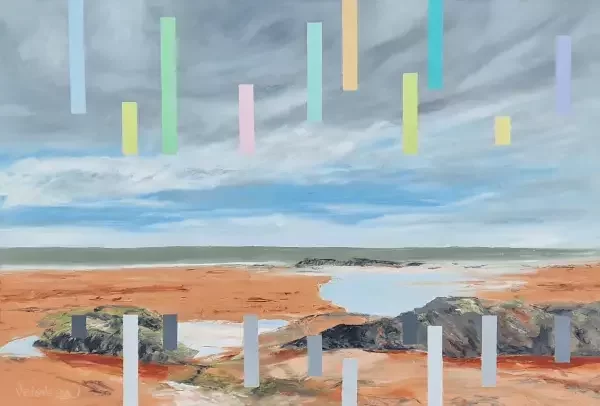
David Hockney's Winter Timber demonstrates how painting can escape the limitations of the photographic moment by incorporating movement, duration, and the experience of looking. The Timeline series pursues the same challenge from another direction. Rather than extending a moment through space, it brings multiple moments together within a single image. The result is not a journey through time, but a meeting point of times. In Hockney's work, time flows.
In the Timeline series, time intersects. And it is within those intersections that the image begins to reveal realities that cannot be seen from any single moment alone.