Curatorial Review of Timeline (2025), oil on canvas, 80 × 120 cm
In Timeline, Margus Veisveer constructs a visually arresting critique of contemporary perception-specifically, the way social media inserts itself between human experience and the natural world. At first glance, the viewer encounters a luminous, expansive sky: layered clouds, shifting light, and a horizon that promises depth and contemplation. It is the kind of view that, before the era of smartphones, would have been received with quiet awe.
But Veisveer interrupts this view.
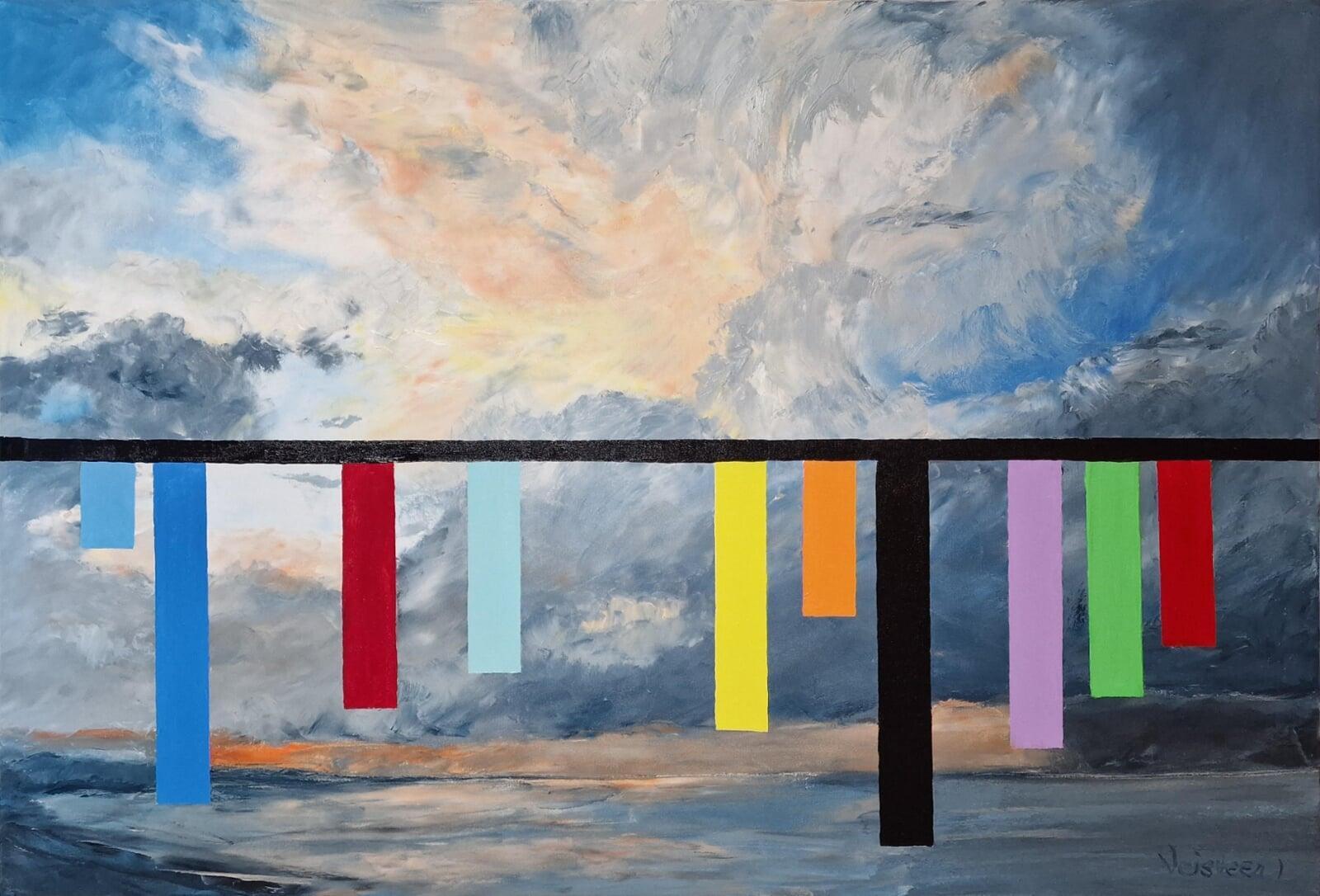
Across the canvas stretches a stark, black horizontal bar-an unmistakable visual metaphor for the social media interface. From it hang brightly coloured vertical rectangles, echoing notification banners, digital tags, user-generated content fragments, or the algorithmic markers that populate timelines on screens. Their artificial hues-intense red, saturated green, digital blue, notification yellow-function not as aesthetic accents but as symbols of interference. These are colours that do not belong to the sky; they intrude upon it.
The result is a landscape no longer seen directly, but through a filter of digital noise. The viewer must look past the rectangles to access the natural beauty behind them, mirroring how individuals today often look at nature only through the lens of their devices: photographing, documenting, performing, but rarely truly seeing.
Veisveer’s composition speaks to a cultural shift. Instead of being present in the landscape, people position themselves in front of it, turning the environment into a backdrop for self-representation. Look at me, not look at this. The natural world becomes content—used, framed, and consumed-its intrinsic value subordinate to the metrics of visibility and sharing.
The painting’s tension lies in this obstruction. The sky is vast, tender, and real; the coloured bars are flat, rigid, and synthetic. The harmony of nature meets the architecture of the feed. Veisveer deliberately imposes this barrier to confront the viewer with the dissonance: our desire for connection with nature versus our compulsion to mediate every moment through technology.
Timeline becomes not just a landscape but a cultural mirror. It asks what has been lost in the shift from seeing to capturing, from experiencing to documenting. And it challenges the viewer to consider whether the “timelines” we scroll through are, in fact, blocking the far richer, deeper timeline unfolding above us.