Perhaps it needs another condition
There is a strange moment in the history of painting when one begins to wonder whether painting has already passed through too many lives. It has been academic, romantic, impressionist, expressionist, abstract, conceptual, deconstructed, revived and repeatedly declared dead. Yet somehow, it keeps returning to the canvas. So what is left for painting to do?
Perhaps the answer is not to invent another style, but to change the conditions under which a painting comes into being.
For me, this question has gradually become more important than the question of style itself. I work with oil paint, a medium burdened with an enormous history. It carries the memory of landscape, portraiture, light and illusion. It carries Monet, Turner, Van Gogh, Picasso and countless others who have already pushed it in directions that once seemed impossible. Yet the medium itself has not necessarily exhausted its possibilities. Perhaps we have simply been looking at it from the same side.
There is an interesting gap between what we call modern painting and what we call contemporary art. Modernism transformed the visual language of painting, gradually separating colour from description, surface from illusion, gesture from representation. Later, contemporary art often moved further away from painting itself, allowing the idea, process or context surrounding an artwork to become more important than the painted image. Somewhere between these worlds lies a peculiar territory: painting knows everything that happened before it, but no longer has to behave according to the rules established by any of those periods.
This is where I find myself increasingly interested - not in leaving painting behind, but in asking whether painting can pass through its own history without remaining trapped inside it.
Traditionally, we tend to think of a painting as something that depicts something. A landscape depicts a landscape. An abstract painting may depict nothing recognisable, but still presents itself as a finished composition. But what if the visible image is only one temporary condition of the painting? What if colour, gesture, light, surface and time are not simply tools used to produce an image, but forces that produce the image themselves?
This changes the position of the artist. The artist does not necessarily apply paint in order to construct a predetermined picture. The artist can create conditions in which pigment is directed, interrupted, accumulated, displaced and allowed to form relationships that could not have been completely predicted beforehand. The painter becomes less of an illustrator of an idea and more of a director of a process. The writer directs a flow of words. The artist directs a flow of pigment. What finally appears on the canvas is the consequence of that direction.
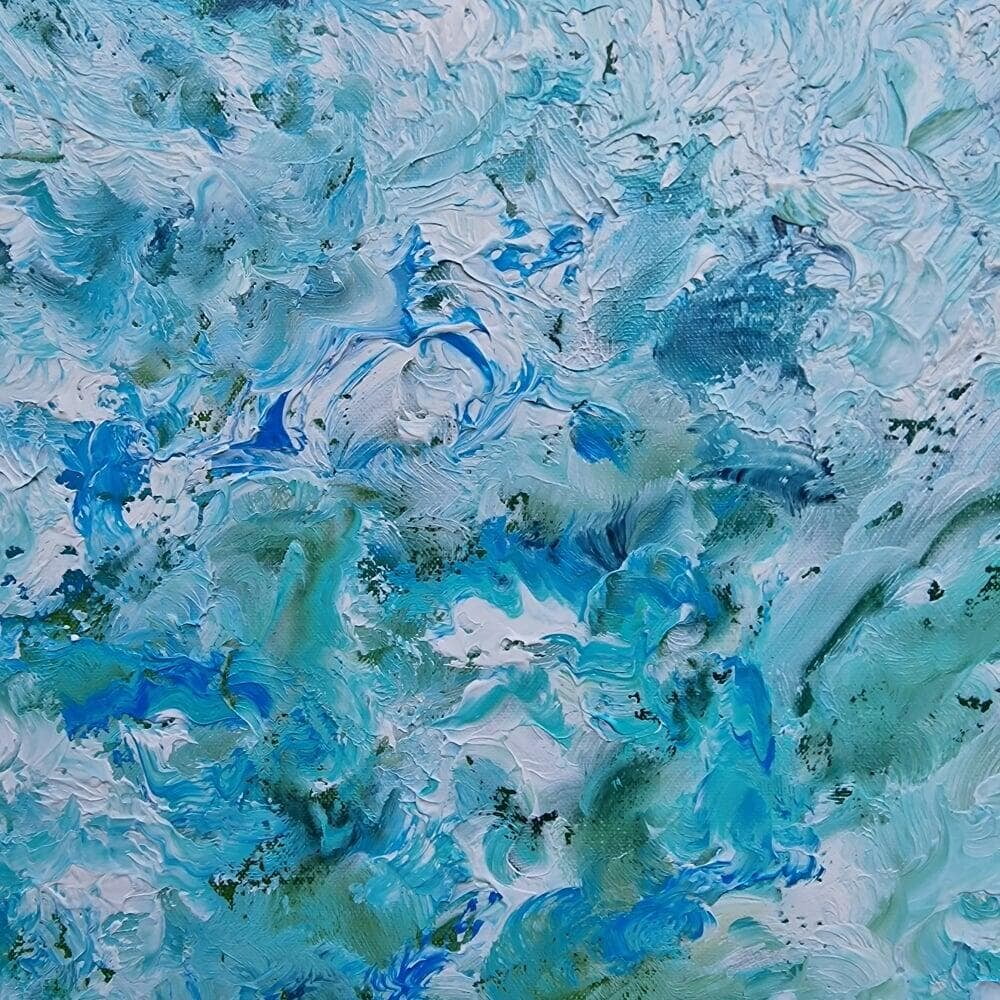
This does not mean surrendering control. Quite the opposite. The more open the process becomes, the more precisely the artist has to understand when to intervene. A mark can destroy a balance. Another layer can make a surface meaningless. One vertical interruption can suddenly change the spatial logic of an entire painting. At a certain point, the artist is no longer simply adding. The artist is deciding what must not be added.
This is where time becomes part of the work. A painting may appear finished while still containing a possibility for another movement. A surface may change under different light, in a different space or from a different distance. The painting therefore has no single, absolute appearance. It has conditions. Perhaps this is one of the places where painting can move beyond some of the assumptions inherited from modernism - not by becoming more complicated, but by becoming less fixed.
This is one reason the idea of Collapse has become important in my recent work. Collapse does not necessarily mean destruction. It can also mean the moment when an existing structure stops being sufficient. After a collapse, something may disappear, but something else becomes possible precisely because the previous structure is no longer holding everything in place.
After Collapse therefore does not have to be understood as a painting of catastrophe. It can be understood as a painting that exists after the collapse of a particular way of seeing. The landscape may still be there. Colour may still be there. The marks, surfaces and spatial suggestions may still refer to things we recognise. But the relationship between them has changed. The painting does not necessarily tell us what happened. It asks what kind of image is possible afterwards.
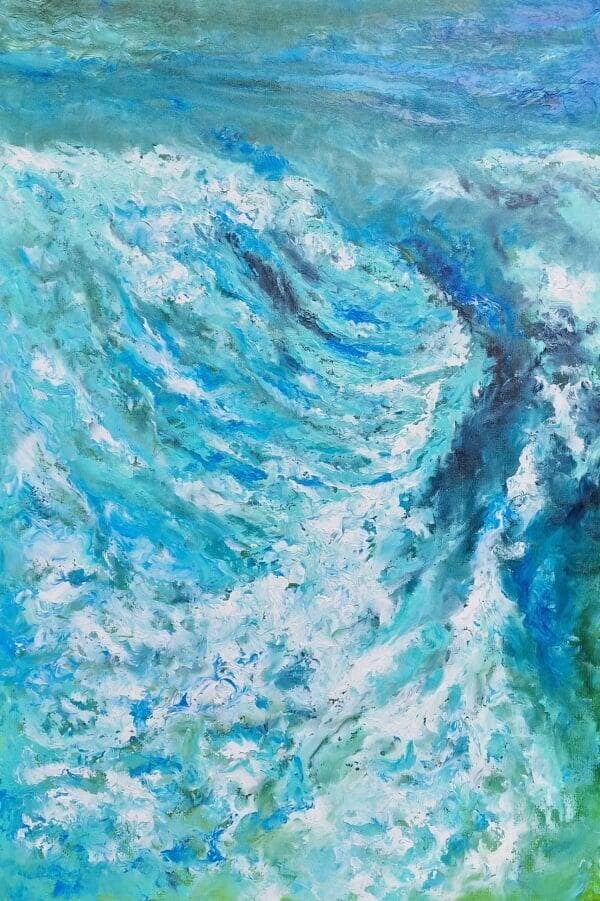
I have used the term Teleexpressionism to describe part of this territory. But perhaps it is misleading to think of it simply as another artistic style. A style usually tells us what something looks like. I am increasingly interested in something that describes how an image moves through time, context and perception. A form can belong to one reality and appear in another. A landscape can contain the memory of a landscape that no longer exists. An object can become a sign, a sign can become a visual disturbance, and a disturbance can become the beginning of a new spatial order.
The painting is then not simply representing a place or an object. It is transposing visual information between different conditions. Perhaps this is why the paintings can sometimes feel recognisable and unfamiliar at the same time. They are not intended to be surreal. They are not necessarily abstract either. They occupy an unstable position between recognition and transformation.
There is, of course, a danger here. If a painting requires too much explanation, something may have gone wrong. A work should not depend on the artist standing beside it and providing the missing instructions. At the same time, I do not believe that every painting needs to be immediately understood. There is a difference between not understanding something and having nothing to discover. The first can be productive; the second is simply empty.
I am more interested in the moment when a viewer recognises something - a colour, a space, a structure, perhaps even a landscape - and then realises that recognition is not enough. Something remains unresolved. The painting continues after the first impression. Perhaps this is where contemporary painting still has an enormous possibility: not in making itself easier to understand, nor in making itself more obscure, but in creating a situation in which understanding can remain incomplete.
I do not think painting needs to escape its history. Nor do I think it is useful to claim that one has simply jumped over modernism, postmodernism or everything that came before. There are no clean jumps in art. There are connections, detours, pauses and unexpected returns. A painting may carry traces of Impressionism without being Impressionist. It may carry the freedom of abstraction without becoming abstract. It may use conceptual thinking without ceasing to be a painting. It may even carry the memory of older forms while pointing towards something that has not yet acquired a name.
Perhaps this is the real journey: not a flight from the past, but a movement through it without permanently landing anywhere.
And perhaps painting does not need another revolution. Perhaps it needs another condition.
A different relationship between pigment and image. Between control and emergence. Between what is seen and what is remembered. Between the painting as an object and the painting as an event. I do not know whether this is a new direction for painting. I would rather leave that question open.
But if painting can still move through its history, carry all of it with it, and nevertheless arrive somewhere that does not quite belong to any of the places it has already visited - then perhaps the journey is not over yet.