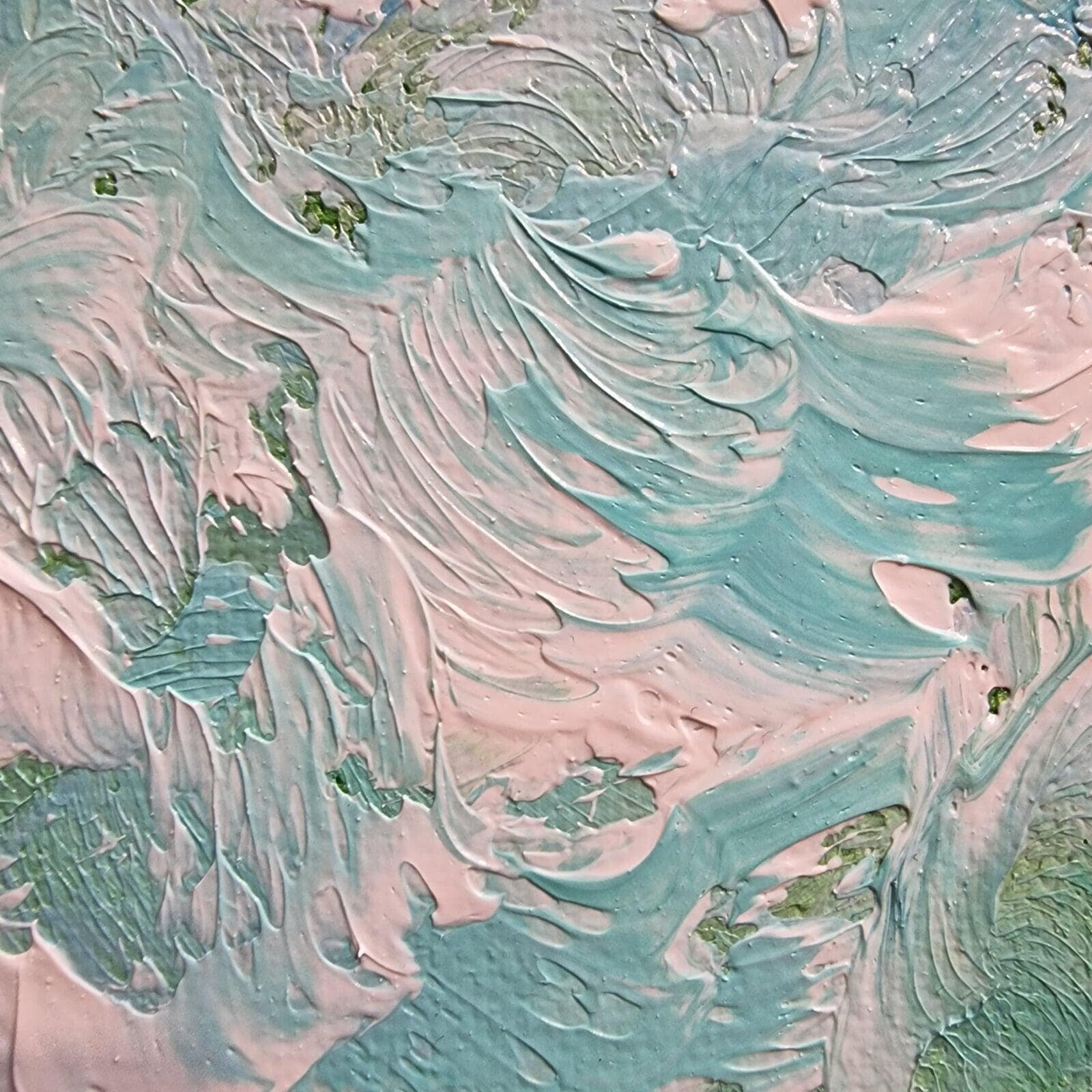
And the longer I look, the more I discover
Calling it “a kind of addiction” may actually be quite appropriate - although, psychologically speaking, I do not mean addiction in the clinical sense.
There is something peculiar about this painting. The closer I look, the less it seems to be exhausted by looking. Instead, it keeps revealing something new.
The eye moves from one microstructure to another: a blue flow, small forms appearing between lighter layers, raised surfaces, reflections, green structures, the direction of pigment movement. And every new discovery creates another question:
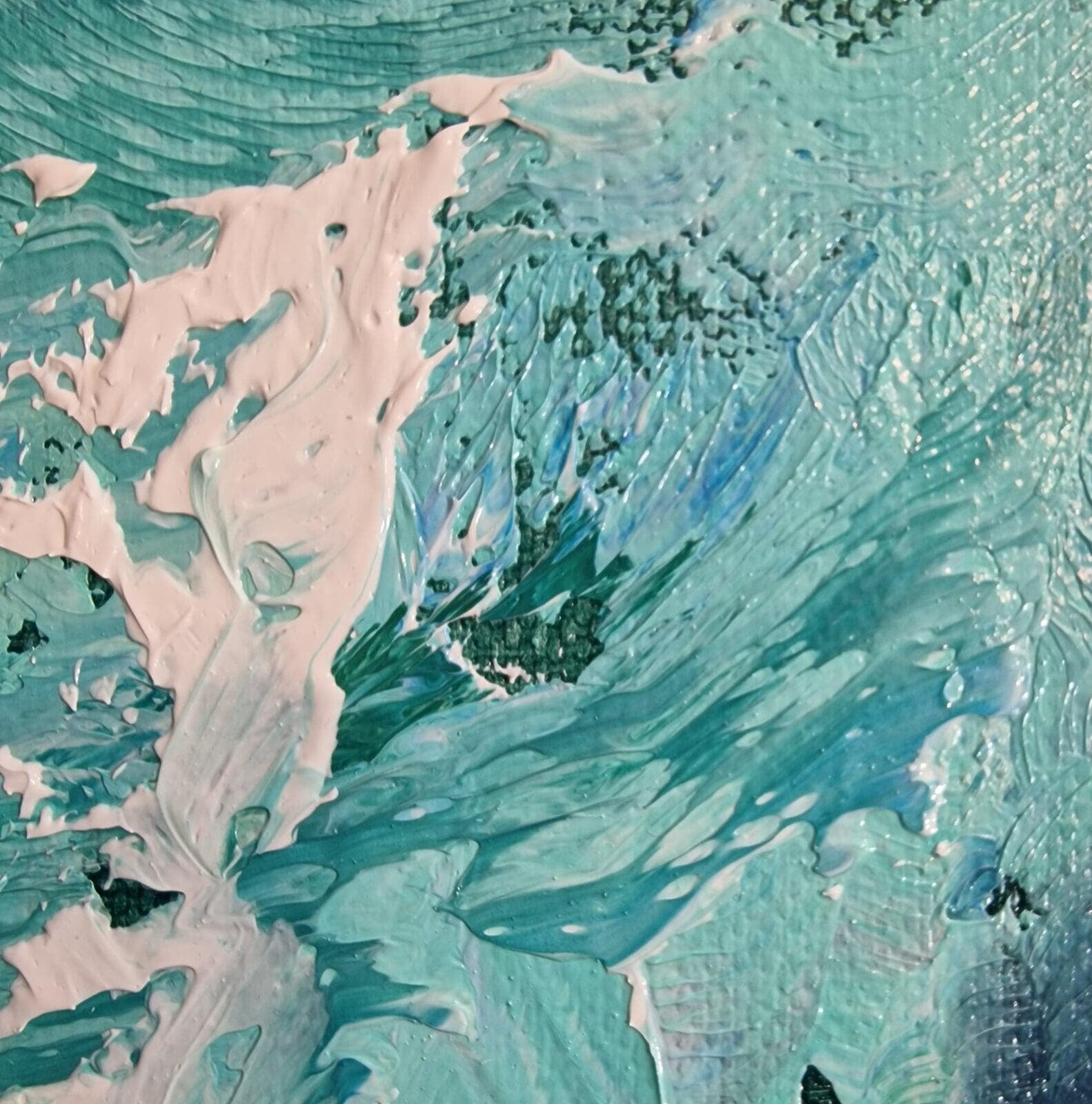
What else is there?
It can create a simple cycle:
With this particular painting technique, this is especially important. The visual information does not exist only in the composition. It also exists at the microscopic level of the surface.
A painting can often be viewed as a whole, and after some time you may feel that you have “read” it. You understand its structure, its visual language, its relationships.
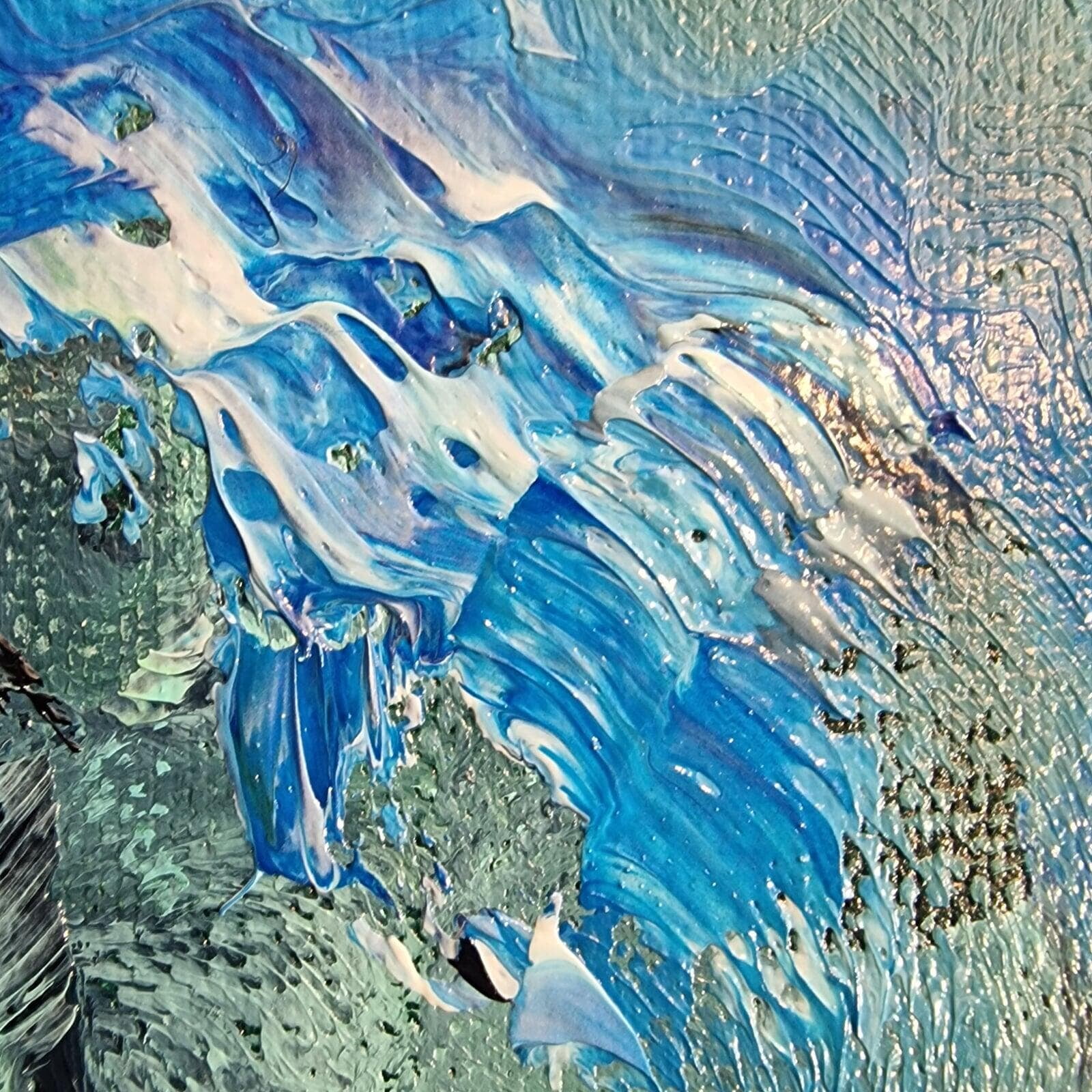
Here, something different happens. The closer you get, the more visual information appears. And there is an enormous amount of it when the painting measures 120 × 80 cm.
There is another interesting aspect to this
I know how this surface was created. I know how the pigment moved, how the layers came together, how I directed the paint. And yet, when I look at the finished surface, even I can see things that I did not consciously plan while painting. The movement and merging of pigments, together with structures created during the drying process, form something that begins to behavelike an independent system. So I am not simply looking at something I made.
In a strange way, I am discovering it after it has already been born. And the longer I look, the more I discover. This becomes particularly obvious in these photographs.
They show details of the painting measuring only about 7 × 7 cm. I do not see them simply as fragments of a blue abstract surface. Why?
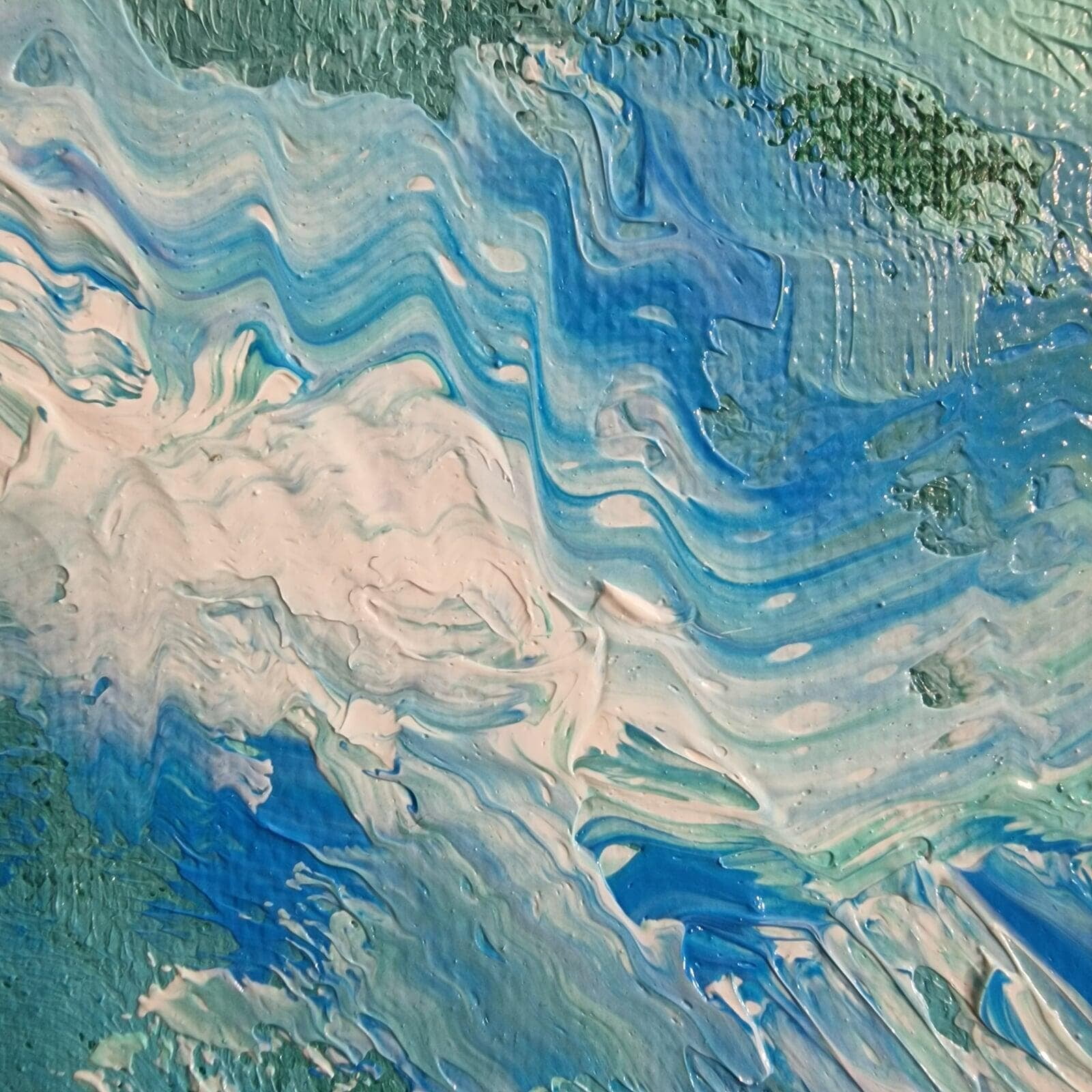
Because at a certain point, some areas begin to resemble an underwater landscape. Others look like geological layers. Still others resemble some enormous biological structure seen under extreme magnification.
And when the distance between the eye and the surface changes, what the image actually is seems to change with it. From about 1.5 meters away, it almost disappears into the whole. Go closer, and suddenly it is there again.
Perhaps this is why I would describe the experience as a kind of visual addiction - or perhaps more precisely, as a perceptual pull.
And in art, I think this can be a valuable phenomenon.
Because if a painting keeps forcing even its own maker to look again and again, then perhaps there is something happening there that cannot be reduced simply to composition, beautiful color, or the formal logic of painting. The painting begins to behave like a living visual environment.
A place you can enter. A place where you could remain for hours. You only have to move closer. A painting is not only something to look at. It is something to explore.